3D Goals
Drying filament without a dedicated dryer
Most filament problems that look like slicer problems are really moisture problems. A spool that has sat open for a month will hiss and pop at the nozzle, leave tiny bubbles on the surface and string badly. A dedicated dryer is the easy answer, but a kitchen oven and a bit of patience work for a hobby bench, as long as you respect the temperatures.
Know your material first
Different plastics tolerate different heat, and the spool itself is often the limiting factor. As a starting point:
| Material | Oven temperature | Time |
|---|---|---|
| PLA | 40–45 °C | 4–6 h |
| PETG | 60 °C | 4–6 h |
| ASA | 70 °C | 4–6 h |
| TPU | 50 °C | 6–8 h |
PLA is the risky one: a spool left in an oven that overshoots to 65 °C will deform and stop unwinding smoothly. If your oven cannot hold a low temperature reliably, skip PLA or use a different method.
Check the oven, not the dial
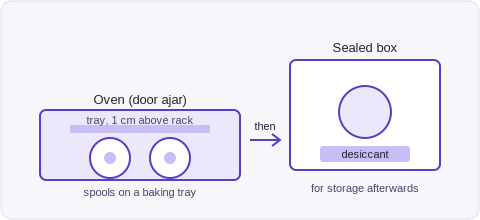
Household oven dials are optimistic by 10 to 20 degrees at the low end. Put a cheap oven thermometer on the rack, preheat for twenty minutes, and note what it actually reads at the lowest setting. Then adjust the dial until the thermometer shows your target. Prop the door open a few centimetres with a wooden spoon so the damp air can leave instead of circulating.
The routine
- Remove the spool from any bag and take off the clip or label that might melt.
- Place it on a baking tray, raised on a rack so air reaches the sides.
- Dry for the time in the table, checking the thermometer once an hour for the first session.
- Let the spool cool in the closed oven for half an hour. Hot filament pulled into a cold room reabsorbs moisture surprisingly fast.
- Move it straight to storage or to the printer.
Judging whether it worked
Print a small stringing test or simply extrude fifty millimetres into the air. Dry filament comes out smooth and silent with a glossy, even surface. If you still hear crackling, give it another two hours; very wet blends and old PETG can need a full day.
Storage afterwards
Drying is wasted if the spool goes back on a shelf. A lidded storage box with a hygrometer and a few rechargeable silica gel packs is enough. Aim for under 20 percent humidity for PETG, ASA and TPU. When the gel changes colour, bake it according to its own instructions and reuse it. For long prints, feed filament from inside a small box with a hole for the tube; it costs almost nothing and keeps the last third of the spool as good as the first.
One last caution: wipe the rack before the oven is used for food again, and never set the oven above what the spool can take. A spool that has softened once is not worth saving, and a replacement costs less than the frustration.